
I’m scared of ghosts as much as I scare me
My life in fast forward, I’m already illAbout the mysteries that I cannot feel
Meet me around the corner
Is it already over?
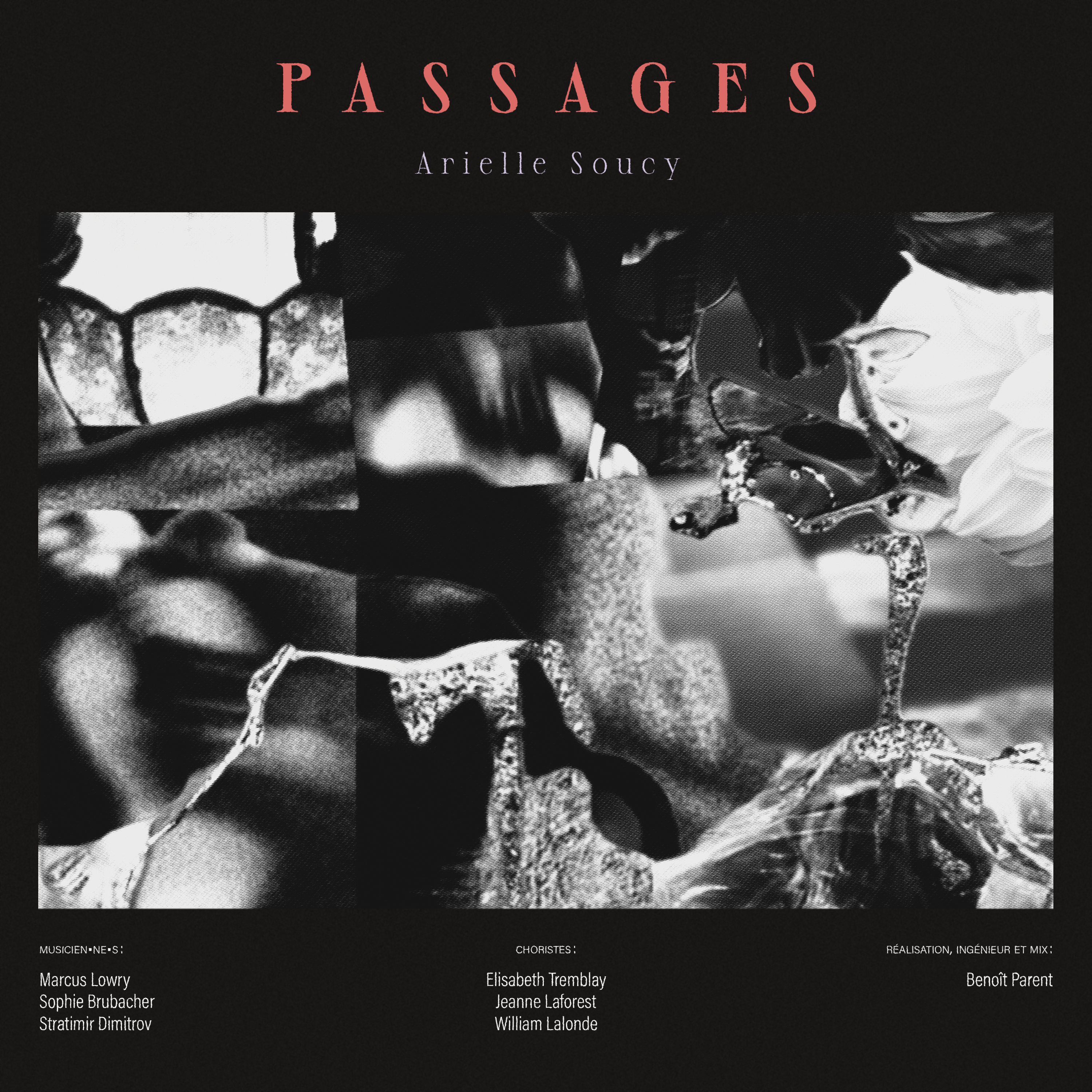
Arielle Soucy‘s sophomore record Passages is a franglais folk dream. Released March 27, 2026 through Bonbonbon, it cements Arielle into a bona fide folk artist. Over nine tracks, Arielle creates an in-depth journey documenting making peace with anxiety, acceptance of the great mysteries of life and learning to be still. For fans and listeners of Passages, Arielle Soucy offers an intangible feeling of the great beyond through plucky guitars, organ, and gorgeously layered vocals.
Of the new album, Arielle says Passages is, “inspired by the purity of early music, the freedom of improvisation, and the words of magnificent authors I stumbled upon, I delved into the incomprehensible depths of my despair to find pathways to a new and subdued faith.”
The album opens with Pattern, a track about anxiety. About being fixated on things out of your own control. I feel seen when Arielle sings, “Donnez-moi une autre tête, donnez-moi un autre corps, je suis fatiguée d’essayer de fonctionner” or “Give me another head, give me another body, I’m tired of trying to function.” Of the season of life I’m in, it exacts the feeling of frustration in trying to find the medium of a life expected versus the reality.
The song itself is haunting and the disembodied. It’s an homage to much of the great indie folk rock artists of the last decade, like Bon Iver or Fleet Foxes. What makes Arielle’s Pattern so special is the use of the organ and the aforementioned disembodied noises that make the listener feels as if they are in a church.

In Nid de vie, Arielle zeros in on the purity of music. The piano, strings and overall arrangement of the song are foundational of music’s simplest but most intricate instruments. Listening to Nid de vie, I feel as though I am standing in an open field, feeling the wind against my skin. I desire for the safe space Arielle’s architects within the song itself, with the second chorus:
J’aimerais me construire un nid
de fleurs tissées de fils séchés
De pluie, d’odeur de vie
Il y aurait des livres à lire
De mots épais, de nuits de guets
De prêles, de hauts-feuillets
Combining themes from Patten and Nid de vie, we can see that these two songs build a world where the writer is faced with the anxieties of their life. And what do we need to feel when we are overcome with emotion? Safe. Secure. In a nest of our favourite, reliable creature comforts.
Varieties of Quiet, the second single, showcases Arielle’s strength as a composer. At the 2:25 mark, Arielle makes a beautiful transition to the fourth verse. A seamless arrangement of vocals and strings overlaid to create a haunting atmosphere.
The song is based on Christian Wiman‘s poem from My Bright Abyss: Meditation of a Modern Believer. When one listens to Varieties of Quiet, they will face the minutia of memories that they harbour in their heads. What stays with you? How is it impacting you? Arielle Soucy tells the listener, “It matters the matter, One mind collects, One memory protects.” They say your thoughts become your actions, so what words and memories stick with you?

On the halfway point of the Passages, we come to Lumière 1 & 2. The tintinnabuli composition of Lumière 1 & 2 builds on the holy and mythical atmosphere within Passages. It is also fostered by the use of the organ, which builds within the song an incredibly haunting and soul-stirring experience. All of the elements of the song are a strategic in building the depth of Passages.
The text itself for Lumière 1 & 2 comes from Névé Dumas‘ Pourritures Terrestres. The inclusion of this text perfectly complements the story that Arielle is building across Passages. The absurdity of life, death, light and darkness. I feel often this album is about accepting our varied states of being — from the physical landscape to our emotional states.
How to Be Me, featuring oui merci, is about learning to be grounded in life. Arielle sings to her lover, “I wish that life could overcome me. Take me far from fantasy to a place I never could have conceived.” For those usually get their head in the clouds, learning to remain in the moment might be a difficult feat. How to Be Me is a comfort for those who yearn for the good things and good people to be waiting for them on the other side of their cloudy days, or better yet: walking alongside them in the storm.

On J’pense que, Arielle reveals a deep fear: of messing up, of death, of not learning to survive. In contrast from How to Be Me, J’pense que offers the listener an intricate portrait of anxiety. The song is raw and incisive. It demonstrates an inward reflection of what trying to find healing while being anxious conjures up for her, which we see when she sings “J’ai tellement peur de toute foirer comme si ça changeait quelque chose/ Y’a rien à manquer – y’a rien à changer.”
J’pense que is not entirely doom and gloom, however, as she ends the song by stating that beauty still exists, even if it’s on the edge of reality. For Passages, J’pense que acts as a necessary shift to underscore the grand experience of life and how coping with it cannot be escaped.

My favourite songs on a record are usually the instrumentals. The earnestness of Rhosymedre (or lovely) is felt upon first listen. It grants us a moment of peace. As a listener, there are two images Rhosymedre (or lovely) inspire in my imagination. The first half made me feel like I found a painting that I loved, wiped its dust off, and was immediately transported to another world.
The second image comes from layered vocals at the 1:14 mark. To me, it sound like a choir coming to greet you during the holidays. Rhosymedre (or lovely) feels like a warm hug before sending you off to the next song.
Around the Corner is the final lyrical song on the record. A song that draws on the complexities of confronting finality. Arielle builds on the anxiety of death and life that she threads throughout the record. Impassioned, she sings, “I’m already ill about the mysteries that I cannot feel.”
For listeners, Around the Corner is an orchestral hymn layered with complexities thanks to the double bass, shaker, and layered vocal performances. It is the perfect combination of sound and words to cap off Passages before its transcendental final track.
And the final song, Passage. It feels like a solemnity to our mortal life. An ode to the beauty of the lush green lands and deep blue waters. Similarly to Rhosymedre (or lovely), there is an earnestness in its composition serving as a beautiful coda to the album. I feel a sense of connectedness to the hums and the harmonies, to the synth and to the organ.
Arielle Soucy and her team of artists clearly have a skillful ability to create songs that are meditations beyond what you can find on the internet. Passage has intention. Passage is a being moving through time and space.
Though it might be subjective to say that Arielle Soucy‘s Passages comes at a very frantic moment in my life, the themes written across these nine tracks are universal. The songs foster a sense of introspection, one that could be done best while on a hike. The inspiration in her lyrics reflect a person’s desire to be seen and to be free from internal anxieties. I have come to a time in my life of great change, and listening to Passages is like hearing my own thoughts amongst beautiful instrumentation and incisive poeticism.
At the church of Arielle Soucy, we, too, consider the matters of mortal life: anxiety, finding safety and meaning. As a person who grew up in a church-going Catholic family, I also really enjoyed the musical arrangements that felt parallel to sitting in a mass. The organ is the best part about being in church. It did not sound disjointed. The composition is fully realized, drawing on comprehensive inspiration.
Folk on the Rocks described Arielle Soucy’s music as where, “traditional folk and modern experimentation intertwine with boldness and emotion.” This aptly encompasses all that Arielle’s music is, especially on Passages. For those who seek refuge and require meditation from their life, take a walk through Passages.
You can listen to Passages below or wherever you find your music.
Have you listened to Arielle Soucy’s Passages? Let me know what you think below.
Leave a Reply